fibon
An auditable white-box AI agent for personal use
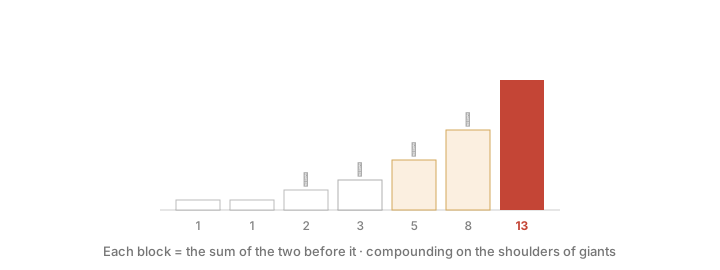
The name comes from Fibonacci — each block stands on the two before it.
This site is not a README, nor technical documentation — it is a design log.
The seed was planted the moment ChatGPT exploded in 2022, but I didn't truly start building until 2026. This log records every discussion with AI and every round of self-debate since I did — every trade-off, and where each "intuitive design decision" actually came from.
You can be an engineer, or not. This log aims to do more than record the build process and its trade-offs — I hope that whatever your background, you walk away understanding AI a little better, and ideally pause at each decision point to ask yourself: if it were you, how would you design this? What call would you make? I give my own answer almost every time, but yours doesn't have to match mine.
Key decisions and debates are marked with special blocks — see the full field guide in "What do these blocks mean?" below.
How to read this log
Readers range from friends who have never written code to senior engineers. The content comes in three interlocking layers — pick the path that fits you:
What do these blocks mean?
A few kinds of blocks recur throughout the log, each with a fixed role. Here they are in person — what they look like, when they appear:
Quick summary: every chapter opens with one of these — 30 seconds to decide whether the chapter deserves a deep read.
You'll also occasionally see margin notes like the one on the right (or the card above) — passing thoughts, recollections, or asides running parallel to the main line. Skipping them costs you nothing.
What implementation details look like (click to expand) for engineers
Code-level evidence for engineers, proving the design above actually works. Collapsed by default — non-engineers can skip every one of these without losing the plot; engineers who want to verify the claims can dig in.
Glossary for non-technical readers
When the log throws jargon at you, this table translates it into plain language:
| Term | Plain-language analogy | Why it matters in fibon |
|---|---|---|
| Token | Like arcade tokens. Every word the AI reads or writes costs tokens. | Saving tokens = saving users real money (project goal 3). |
| Sandbox | Like an isolation ward. However wild the patient gets, nothing escapes the room. | Protects your computer from unfamiliar or malicious code the AI runs (ch. 6). |
| Coroutine | Like a hyper-efficient barista. While the espresso machine pours (I/O wait), they turn around and take the next order. | Lets fibon juggle hundreds of tasks without freezing (ch. 6). |
| Atomic | Like a bank transfer. Either the debit and the credit both happen, or neither does — never "half-transferred". | Ensures safety limits and state can't be bypassed mid-crash (ch. 2). |
| Vector similarity | Finding data by intent and meaning, not literal keyword matching. | The AI hears what you mean even when you don't say the exact keywords (ch. 3, 4). |
| Session | One chat window, or a single conversation thread. | fibon's biggest target pain point: an AI that remembers you across chat windows (ch. 3). |
| Skill | A work manual written for the AI: how to perform a specific task. | Auditing whether the LLM actually followed the manual is the core of ch. 4. |
| Scope | Who a memory belongs to: personal, a specific project, or global. | Keeps memories from different contexts from contaminating each other (ch. 3). |
| Ingest | Like the brain organizing the day's memories into notes while you sleep. | The background process that turns messy conversations into structured memory cards (ch. 3). |
| ADR | Architecture Decision Record — a written memo of "why we picked A over B at the time". | Every major fibon design has one; the log cites them constantly. |
| MCP | Model Context Protocol — the standard plug that lets AI connect to external tools. | Ch. 4 and 6 dig into how fibon splits "trusted" from "untrusted" tools with it. |
| A2A | Agent-to-Agent protocol — a standard for AIs built by different teams to talk to each other. | Already supported; future assistants can cooperate across products. |
The four project goals
Every design trade-off in fibon ultimately gets tested against these four:
🛡 Make AI safe and controllable — through engineering
We don't beg the LLM to behave or pray a prompt holds. We rely on code-level hard boundaries, human approval before critical operations (human-in-the-loop), and complete audit trails with no blind spots.
🎯 Curate exactly what the LLM sees
The point isn't letting AI "see more" — it's "see better". We'd rather have it act precisely on the 5 most relevant long-term memories than stuff 50 noisy ones into the context.
💰 Slash token costs
Caching, dynamic tool selection, and layered filtering put every cent where it counts — expensive models shouldn't burn for nothing.
🤝 Make AI a true personal assistant
Not a disposable coding tool, not a stiff service bot — a companion that remembers the big and small things over the long run. Every conversation accumulates into your personal knowledge base instead of being thrown away.
Chapters
📖 Written for everyone — key decisions highlighted in sidebar blocks. Each chapter opens with a quick summary; skim it first, then decide whether to go deep.
Why I'm Building My Own AI Assistant
A seed planted the moment ChatGPT exploded — and why I didn't start building until 2026
Is One AI Not Enough?
Why fibon splits the Butler from the Assistants, and why the rules of delegation must be hard-coded instead of merely "asking" the AI nicely
More chapters are being translated — the Traditional Chinese version is the source of truth.
Field Notes
📰 A different clock from the serialized chapters — principle-level teardowns of AI infra incidents, each ending with how it maps onto fibon's design: which bug classes have no surface to attach to, and which defenses we still haven't built. Updated as events warrant — full list here.
Zombie Caches and Stolen Keys: A Teardown of Two Runaway AI Bills
Reverse-engineering how Google's billing system broke from the shape of a BigQuery export — and an honest audit of which defenses fibon has built, and which one is still missing
Runaway Sub-Agents: The June 2 Claude Outage and the Lesson of the Infinite Loop
A bug that made sub-agents multiply exponentially knocked Claude out for nearly six hours. fibon's delegation-round cap and multi-vendor design are built for exactly this kind of runaway — but one piece I haven't built either.
The Attack That Waits: When AI's 'Memory' Becomes the Attack Surface
OWASP put memory poisoning in its 2026 agentic top ten; a single poisoned webpage can make an agent misfire weeks later. fibon sells memory as a core feature — this cut lands right on the vital spot.