Field Notes
The Lobster's Bill: When an AI Agent's 'Token-Eating Monster' Meets the Abandonment Wave
OpenClaw drove the whole world to "raise a lobster" — then the same crowd abandoned it because $150/day in token fees made it unaffordable. The economics of that craze is exactly fibon's core thesis.
Quick summary: In the first half of 2026, OpenClaw — an open-source AI agent by Austrian engineer Peter Steinberger, mascot a red lobster, nicknamed “lobster-raising” in Chinese-speaking communities — went so viral that Jensen Huang called it “the most popular open-source project in history.” Then came the abandonment wave: heavy users burning over $100/day in token fees, “can’t afford it.” The cost economics of that craze is exactly the problem fibon has been solving since day one.
Skip this if: you already know “an autonomous agent = a continuous token burn,” and don’t need a live case study.
A lobster that eats money
OpenClaw’s rise was the most surreal tech phenomenon of early 2026. It’s an open-source autonomous agent by Austrian engineer Peter Steinberger — it doesn’t just answer questions, it operates files, browsers, and schedules, taking commands over LINE, Telegram, WhatsApp. Because the logo is a red lobster named Molty, Chinese-speaking communities vividly call “installing and deploying OpenClaw” raising a lobster. Its GitHub stars cleared 200,000 within weeks, and Jensen Huang, in a GTC keynote, called it “the most popular open-source project in human history,” surpassing in weeks what Linux built over thirty years.
Then the bill arrived.
HK01’s March 12 report named the key mechanism: even saying “hello” to your lobster burns tens of thousands of tokens — because an autonomous agent force-loads a pile of background data and config before every turn. Shenzhen saw crowds “lining up to adopt a free lobster”; within a week it flipped to a “release the lobster” removal wave. The headline was blunt: $150/day in token fees, can’t afford it.
What the cost actually looks like
Laying out the circulating figures (mind the source tiers):
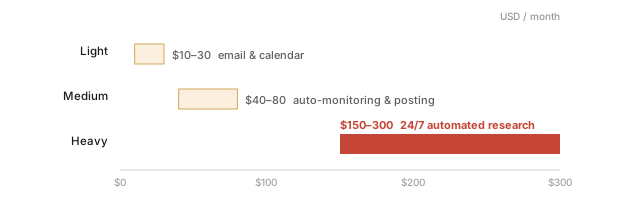
Authoritative outlets most often cite monthly-fee tiers: light users (email, calendar) ~$10–30/month; moderate (auto-monitoring crypto, auto-posting) ~$40–80; heavy (24/7 autonomous research) ~$150–300. A separate task-count-to-token set circulates in community how-to posts: light at 10 tasks/day ≈ 30M tokens/month; an automation team at 200 tasks/day ≈ 600M tokens/month. I couldn’t verify that token set word-for-word in a single authoritative source — treat it as an estimate.
But the truly staggering number comes from the developer himself. On May 15, Steinberger posted an OpenAI API bill screenshot: his three-person team, running ~100 Codex instances, burned $1.3 million in 30 days — 603 billion tokens, 7.6 million requests. He clarified this reflects Codex “Fast Mode” pricing; turning that off drops it to ~$300K, and the bill was footed by his employer, OpenAI — it’s a stress test of “what software development becomes if token cost is no longer a constraint,” not a normal user’s bill. But it takes one fact to the extreme: an autonomous agent is, in essence, a continuously-running token furnace, and how hard it burns has almost no ceiling.
What this means for fibon
OpenClaw’s abandonment wave is almost a live-action reality show of fibon’s third project goal — drastically lowering token cost. When I listed it as one of the four goals in Chapter 1, it sounded abstract; the lobster’s bill makes it concrete: a personal-assistant agent that doesn’t solve token economics will, however capable, get abandoned under the weight of its own operating cost. This isn’t a nice-to-have optimization; it’s the life-or-death line for whether this kind of product can survive.
fibon’s answer to that line is the “metering factory” that Deep Dive C is entirely about. A few key levers: on the input side, reverse-engineering prompt caching (arranging the system prompt into a cache-friendly staircase), Stratified RAG to avoid dumping all 50-plus tools’ full schemas into the LLM every round, and context scoping to retrieve only the most relevant memory cards rather than pouring in the whole memory. Just trimming the conversation-history window from “carry everything every round” to “keep 2 rounds” saves substantial tokens across vendors without losing quality.
But facing OpenClaw’s bill, I have to flag honestly what fibon hasn’t finished building:
And a point that connects to the zombie-cache note: in OpenClaw’s abandonment wave, the most crushing part wasn’t “expensive,” it was “expensive with no brakes” — you sleep, you wake, the bill is over $100, and nothing intervened. This is exactly where the global spend circuit breaker I keep mentioning belongs. fibon’s ADR-010 already has a per-user daily budget prototype; generalize it into a pre-call gate for every LLM call, degrading to a local small model on breach rather than silently burning money — for a personal assistant’s long-horizon operation, “degrade, don’t black-out” fits better than a hard cap.
The lobster craze will eventually settle into one consensus: the real barrier for autonomous agents isn’t “can you build it,” it’s “can you afford to keep it.” And “afford to keep it” is an engineering problem, not a marketing one. Whoever first solves token economics down to financial viability is the one who actually owns the “personal AI assistant” market.
Sources
- Raising a lobster' costs a fortune — $1.3M/month, billed to OpenAI — TechNews (2026-05-18, zh-TW)
- The lobster effect: Apple Mac shortages, Foxconn and Lite-On see orders — Economic Daily (2026-04-10, zh-TW)
- What is OpenClaw 'lobster-raising,' and why the abandonment wave — Business Weekly (2026-03-27, zh-TW)
- China's tech firms feast on OpenClaw — CNBC (2026-03-12)
- Uninstall wave hits OpenClaw: $150/day token fees, can't afford it — HK01 (2026-03-12, zh-TW)
- Global lobster-raising craze, players burning 1B tokens a day — TechBang (2026-03-10, zh-TW)